Monday, 18 April 2011

Beanbags

Today's new product upload are these fun beanbags. They can either be used singularly as hacky sacks or in quantity as juggling balls. To view this product's page, please click https://sorazora.com/product/juggling-ball/

These organic crocheted beanbags are available to buy in sets of three or singularly and in a choice of natural fibres. Both Himalayan Nettle (pictured above) and Wild Nepali Hemp (pictured below) yarns have been harvested, retted and handspun by the craftspeople of remote Nepalese villages.

The natural seed filling (pictured below) gives them a firm texture and an ideal weight that would suit both advanced jugglers and beginners alike.


Sunday, 17 April 2011

Natural Button Selection

Today's final new product upload are these beautiful handcrafted buttons. To view the product page, please click here!

These natural undyed buttons have been handcrafted from coconut shell, bamboo and peach stone. They are an ideal choice for natural fibre clothing. With four styles to choose from, the small coconut buttons come in a sets of 6, the medium coconut and peach stone are in sets of 5 and the bamboo buttons come in a set of four. The peach stone buttons vary in size, but average 23mm in length.


Hemp & Nettle Cordage

Today's first new product upload is an organic choice of Himalayan nettle or wild Nepali hemp cordage!

These undyed cordages have been harvested and spun by the craftspeople of Nepal's remote villages. Coming in lengths of 25m, they are perfect for heavy use in the garden and tent or yurt construction.

The above photo shows the 100% wild Nepali hemp cordage, a perfect choice for the environmentally conscious gardener. To view this product's page, please click here!

The photo below shows the 100% Himalayan nettle cordage. The soft, flexible and strong fibre make this ideal for a wide range of secure lashing. To view this product's page, please click here!


Monday, 11 April 2011

Nepalese Silk

The photo above shows two varieties of cocoon. The bright yellow colour of the cocoon on the right is totally natural, but yields less fibre than the white cocoon. Each cocoon is made from one long continuous fibre, the white producing between 1000 to 1500 metres and the yellow only producing around 600 metres.

Our silk products, most notably our silk scarves, are produced in India and imported into Nepal. This is a situation that we are hoping to change with the help of Tej (an instructor of silk production). Tej works for a government-run silk factory in Banepa, just outside Kathmandu and also produces silk yarn at his home.

Spinning the silk fibres by hand is a time consuming task, especially if you wish to maintain the same quality and size of yarn. Our use of silk allows for the silk worm to be removed from the cocoon, whereas other forms of yarn production require an undamaged cocoon to be boiled before unravelling.
One of the many aspects of silk production that Tej teaches to remote villagers is how to prepare silk for long term storage. The above photo shows the cocoon being loosened in water then stretched onto a wooden frame. Upto 250 cocoons can be spread onto the frame and left to dry. Many of the remote villagers tend to supply Tej with cocoons in the natural state after cutting open the cocoon to remove the silkworm.

The above photo shows Kiran, our dyeing master, and Tej, the silk expert, discussing the finer details of silk fibre.

Sunday, 10 April 2011

Button Production

Buttons are an important part of most garments and we want to make sure that the materials we use and production methods fit with our business ethos. We want to use sustainable natural materials, such as coconut shell, bamboo and peach stone. We do also use buffalo bone and buffalo horn, but try to keep the use of those materials to a minimum as it would be a shame for vegetarians if they appreciated our garments, but could not wear them due to a single button.

The above photo shows a worker shaping a horn button on a lathe and below shows workers carving intricate designs into each button. Electricity is vital for the operation of all the machinery, so a large generator is a neccessary evil to cover the many hours of scheduled powercuts.

This factory has been in business for over ten years and is probably one of the most organised factories I have seen here. It is with the same factory that we produce all of our paper tags and cards, other crafts available through this factory are various kinds of metalwork. Because of the professionalism of Surjaman (the manager) and the warm, friendly environment created by the staff (currently over 120 people are employed here!) we hope for a long and successful business relationship!!


Friday, 1 April 2011

Supari Nut Pendant

Supari nuts (Nepalese name) can be commonly found in much of the tropical Pacific, Asia and parts of East Afica. It is also commonly known as betel nut as it is often chewed wrapped in betel leaves and sold as Paan. The botanical name for the palm that produces these nuts is areca catechu.

My interest in supari is strictly for its beauty and potential use for jewellery. In its dried state, it is easier to carve and shape than bone or horn and offers a unique  combination of natural brown and ivory patterns. Two sizes of the nut can be found here in Nepal, the smaller of the two I will craft into beads with the largest providing enough material for a fair sized pendant. The photo below shows a pendant that I crafted for our 2011 collection's photoshoot. In the coming months I will work more with this nut and the results will be available to view through our online shop.


The areca nut is not a true nut but rather a drupe. In botany, a drupe is a fruit in which an outer fleshy part surrounds a stone. In the ripe fruit the husk becomes yellow or orange and, as it dries, the fruit inside hardens to a wood-like consistency.

Areca nuts are chewed with betel leaf for their effects as a mild stimulant, causing a mild hot sensation in the body and slightly heightened alertness, although the effects vary from person to person. The effect of chewing betel and the nut is relatively mild and could be compared to drinking a cup of coffee. In my experience, drinking coffee will always come before chewing areca nuts!


Friday, 25 March 2011

Paper & Packaging

One particular issue that we face in retail is the type and amount of packaging used.
Naturally, there has to be compromise within some elements of our labeling as certain information has to be provided with each garment. The swing tags, labels, business cards and packaging are all made from hemp or lokta paper.

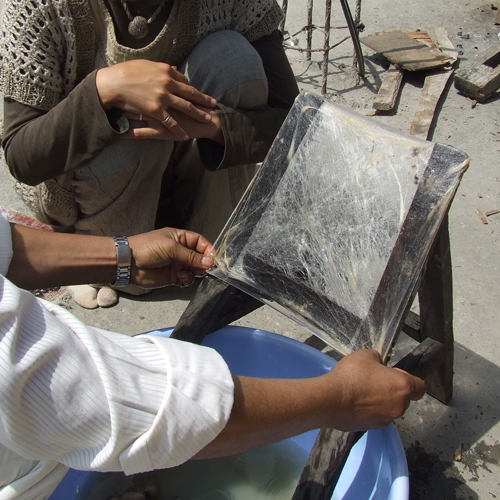
The images above and below show the recycling of wastage hemp and lotka paper. The framed screen is lowered into a bath to provide a level surface onto which the liquid pulp is poured. After checking that the thickness is even, it is placed in the sun where it dries fairly quickly. Fresh sheets of recycled paper are born.

The image below shows the care and attention given to the screen printing of our washing instruction tags. Each tag is printed and allowed to dry before the reverse side can be printed.

The image below shows a selection of our tags and labels. We feel that sustainable production is vital for our entire collection right down to the last detail. The use of hemp and lotka paper is the natural choice!

Lotka paper is handmade traditionally from the bark of Daphne Papyracea (Lotka). These plants can be found in the forests of Nepal between the altitudes of 2000 metres to nearly 3000 metres. Nepalese farmers allow sufficient time for these plants to redevelop, therefore the production of this paper does not affect Nepal's fragile forest ecology.